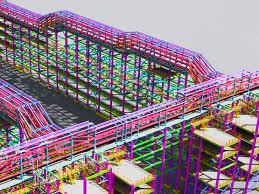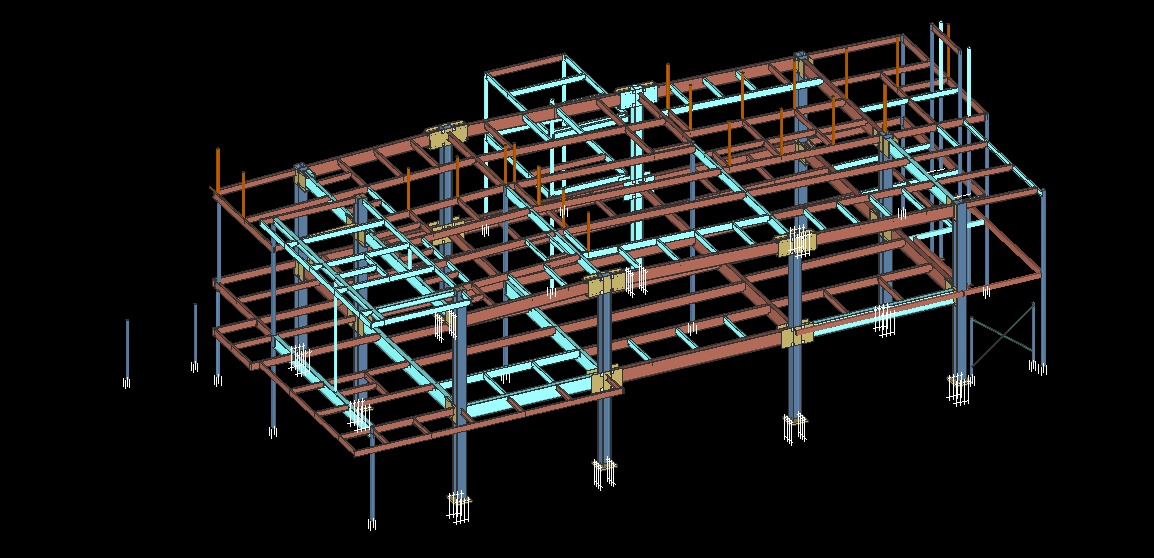
Structural Steel Detailing
What is Structural Steel Detailing?
Structural steel detailing is a specialized process that involves creating detailed drawings, plans, and reports for the fabrication and erection of steel structures. These details help fabricators and contractors in the accurate manufacturing and assembly of steel components, ensuring structural integrity and compliance with design requirements.
Steel detailing is a critical step in the construction of buildings, bridges, industrial plants, and other steel structures. It translates structural design into precise instructions that fabricators and erectors can follow to assemble a stable and safe structure.
1. Key Components of Structural Steel Detailing
A. Shop Drawings
Shop drawings provide a detailed representation of each steel component that will be fabricated. They include:
Dimensions and specifications for cutting, welding, and drilling.
Material details (steel grades, thickness, etc.).
Information about bolts, welds, and other fastening methods.
Surface finish details (e.g., paint or galvanizing requirements).
B. Erection Drawings
Erection drawings help in the assembly and installation of steel components at the construction site. They include:
Placement and orientation of steel members (beams, columns, braces, etc.).
Connection details for joining members.
Assembly sequence and special instructions for installation.
Reference points and anchor bolt locations.
C. Bill of Materials (BOM)
The BOM is an essential part of steel detailing, listing all required materials, including:
Steel sections (beams, columns, plates, etc.).
Bolts, welds, and fasteners.
Paints, coatings, and surface treatments.
D. Connection Details
Steel members are connected using different techniques such as:
Bolted Connections – Common for easy assembly and disassembly.
Welded Connections – Provide strong joints but require skilled labor.
Moment Connections – Used where rigidity is needed in a structure.
2. Standards & Codes in Steel Detailing
Structural steel detailing must comply with industry standards and regulations to ensure safety and quality. Some key standards include:
AISC (American Institute of Steel Construction) – Used in the U.S. for design and fabrication.
ASTM (American Society for Testing and Materials) – Defines material properties.
BS (British Standards) & Eurocodes – Used in the U.K. and Europe.
IS (Indian Standards, IS 800, IS 808, etc.) – Indian standards for steel structures.
AWS (American Welding Society) – Governs welding specifications.
3. Software Used in Structural Steel Detailing
Modern steel detailing relies heavily on specialized software for precision and efficiency. Some commonly used software includes:
Tekla Structures – Industry-leading software for 3D steel detailing.
AutoCAD – Used for 2D steel detailing and drafting.
SDS/2 – Provides automated detailing and connection design.
Advance Steel – An Autodesk software for 3D modeling and detailing.
Revit – Used for BIM (Building Information Modeling) and coordination.
ProSteel – A Bentley Systems product for steel detailing and design.
4.Importance of Structural Steel Detailing
A. Accuracy & Efficiency
Precise detailing reduces errors in fabrication and assembly.
Minimizes material wastage and rework.
B. Cost & Time Savings
Proper detailing leads to efficient manufacturing and installation.
Reduces delays and unexpected costs during construction.
C. Structural Integrity & Safety
Ensures that steel components meet load-bearing and safety requirements.
Complies with industry codes and regulations.
D. Coordination & Collaboration
Facilitates seamless communication between engineers, architects, fabricators, and contractors.
Helps in resolving design conflicts before construction.
5.Challenges in Structural Steel Detailing
Complex Designs – Handling intricate architectural features and connections.
Coordination Issues – Ensuring smooth collaboration between multiple teams.
Revisions & Updates – Managing frequent design changes.
Adherence to Codes – Keeping up with evolving industry standards.
Conclusion
Structural steel detailing is a crucial process in the construction industry that bridges the gap between design and fabrication. It requires precision, technical expertise, and compliance with industry standards. With advancements in 3D modeling and automation, steel detailing is becoming more efficient, reducing errors and ensuring high-quality structural assembly.
Would you like help with a specific aspect of steel detailing, such as software selection, detailing techniques, or industry best practices?